“Listen to a selection of O-Roll music played on the Coinola SO – scroll down, click on any tune or sheet music cover” The history of the development of Coinola machines and the O-Roll format can be found at https://r...

Over 700 of the total 1270 “O” Rolls estimated ever made by QRS, Columbia, Capitol and Clark are catalogued and presented including tune composers.

The complete catalog of all 933 music rolls ever originally produced by Hupfeld for the Phonoliszt-Violina: Catalog Sorted by Roll Number Catalog Sorted by Composer. Also provided is the catalog of the 268 rolls chosen from over 20 collections and museums – and recut with the goal of producing the "reference set" of music for the PV.
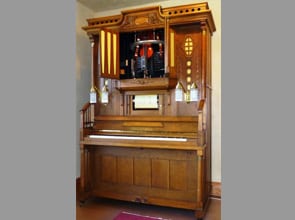
Phonoliszt-Violina: In the 1900 to 1930's the automatic music machine replaced live performers accelerated by union pressures for uneconomic rates for performers. Many types of player pianos, orchestrions, and violin and banjo players) grew rapidly as an early musical media for playing music in commercial locations and homes.
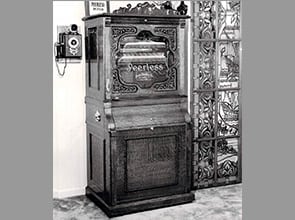
The Peerless line of coin-op player pianos, nickelodeons and orchestrions were the earliest roll-operated coin-operated music machines on the market; Companies involved were the Roth & Engelhardt Co., Peerless Piano Player Co., National Music Roll Co., Engelhardt Seybold Co. and Engelhardt Piano Company.
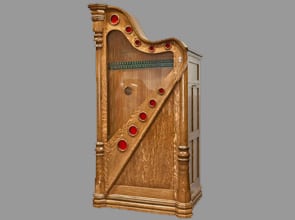
The Automatic Harp invented by J.W. Whitlock and popularized by the Wurlitzer Company. Whitlock was a classic American inventor, business leader and entrepreneur who became the heart and soul of Rising Sun, Indiana in the early 1900’s. His life, his inventions, his boat-racing competitions on the Ohio River and his businesses are described in a storied life pursuing the American Dream. The Harp is an early automatic music machine that helped spread ragtime as a national music form.

1910 German-made mechanical orchestra shipped through newly-opened Panama Canal to Nevada City, California to play in a gold rush saloon owned by Ernie Schreiber. Named the Popper Felix orchestrion, it has extensive instrumentation for playing classical as well as popular music. Uncovered by Rick Crandall, restored by Hayes McClaren and now in the Jim Krughoff collection.
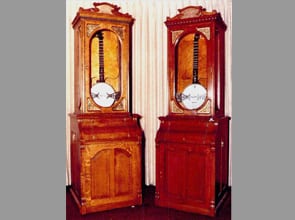
The Encore Automatic Banjo is one of the first commercialized automatic coin-op music machines in1897. It operated from a perforated paper roll controlled in similar fashion to player pianos. This article is based on original company records of the American Automusic Company and the Auto-Manufacturing Company.